
Rediscovering a forgotten perfume: why it feels so joyful
You open a drawer looking for something else, and there it is: a perfume you had almost forgotten. You spray it once, and before you can name a single note, you feel something.
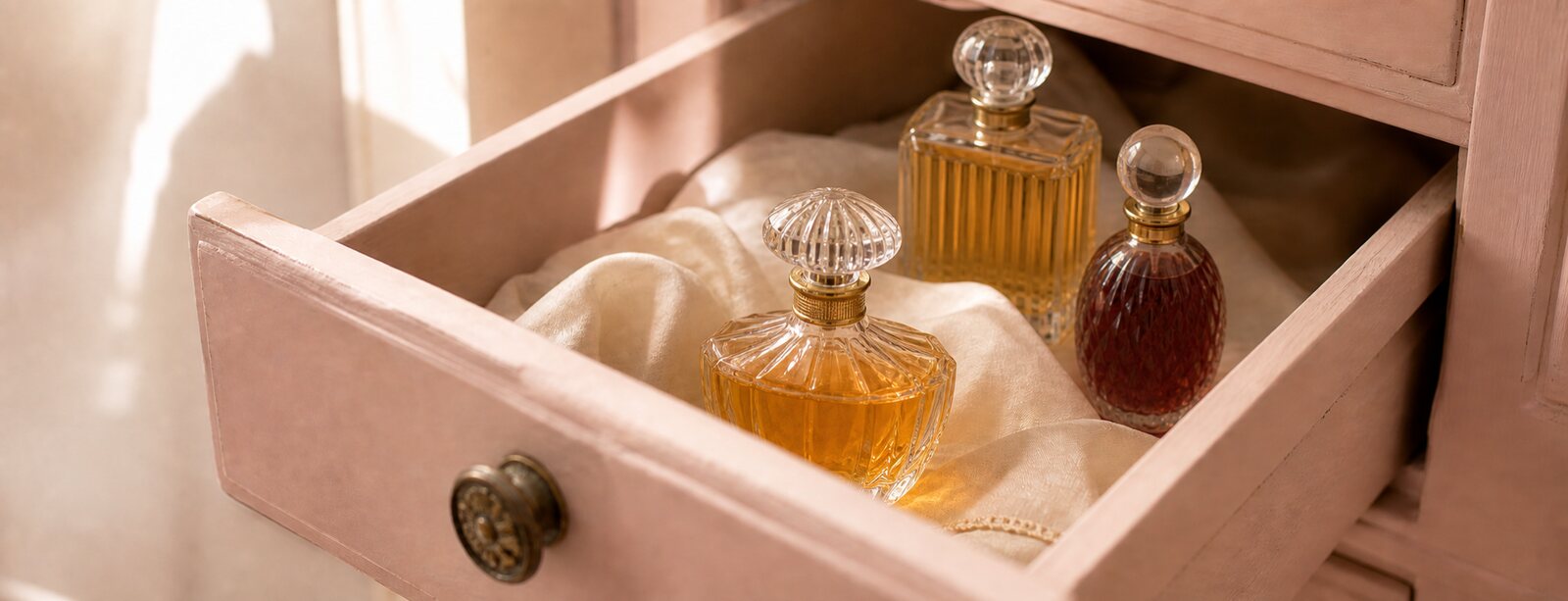
Scent can work like a personal time capsule
Smell and autobiographical memory have a long-studied relationship. Odors attach themselves to places, people, routines and moments that mattered, and meeting one again can bring part of that experience back into view.
The research is more careful than the popular version of the idea, though. Odors actually cue fewer memories than words or pictures, and more slowly. And when memories tied to smell are compared with memories tied to the other senses, they do not come out more emotional or older.
What does hold up is narrower and still worth knowing: when a smell does bring back a good memory, that can lift how you feel. Not every bottle will do it. The ones that do tend to be the ones you wore through something.
A perfume is unusually good raw material for this. You may have worn it through one job, one relationship, one season or one version of yourself, until the fragrance and the experience ended up filed next to each other.
The surprise is part of the pleasure
We adapt quickly to whatever stays visible. The bottles at the front of a shelf become the default, and the ones behind them quietly stop being options. A forgotten perfume escapes that.
When it comes back, two things happen at once:
- You recognize it.
- You meet it with some of the freshness of a first impression.
That combination is unusually satisfying. The perfume is known, but not recently known. You remember what you liked about it while noticing details you had never registered.
Perhaps the opening is sharper than you remembered, or the drydown softer. Your taste has moved too. Rediscovery is not a replay of the past; it is a meeting between the perfume, who you were and who you are now.
A forgotten bottle is not an unloved bottle
Perfumes leave a routine for ordinary reasons. The weather changed. Something new arrived. The bottle moved to another room. The occasion you associated with it stopped happening. None of that is a verdict on the fragrance.
Blind spots are normal, and they have nothing to do with how many bottles you own. Samples stay in pouches, travel sprays move between bags, and a taller bottle stands in front of a shorter one for a year.
So rather than reading an unworn perfume as waste, it is fairer to read it as an unopened invitation. It may not need to be worn often. It needs one more honest encounter.
How to rediscover a perfume without forcing it
Rediscovery works best when it stays curious rather than corrective. None of this is a schedule.
Bring one bottle back into view
Pick a fragrance you have not thought about lately and leave it somewhere you will see it for a few days. Do not make yourself wear it. Just let it back into the field of choice.
Smell it before you read about it
Skip the note list and the reviews for now. Spray it on paper or skin and notice your own reaction first. What arrives before the analysis does?
Give it an ordinary day
A perfume does not need an occasion to matter again. Wearing it to work, on a walk or to see a friend builds a new association instead of asking the bottle to reproduce an old one.
Write a sentence, not a score
One line is enough: this still makes me feel dressed up, or I had forgotten how comforting the drydown is. A sentence keeps the personal part, which a rating out of ten throws away.
Let the answer be no
Sometimes rediscovery confirms that your taste has moved on, and that is a useful answer too. You can pass the bottle to someone who will love it, keep it for what it reminds you of, or simply stop expecting it back in regular use.
Your collection can still surprise you
The perfume world always has something new, but novelty is not only found in the next purchase. Sometimes it is sitting in a bottle you already chose once.
The pleasure of rediscovery comes from recognition, from change, and from the fact that scent reaches you before you have decided what to think. A forgotten perfume can show you where you have been — and that what you already own still has experiences left in it.
Sources and further reading
- Rachel S. Herz, “The Role of Odor-Evoked Memory in Psychological and Physiological Health”, Brain Sciences, 2016. Reviews evidence that odors evoking positive autobiographical memories can raise positive emotion and lower physiological markers of stress.
- Maria Larsson, Johan Willander, Kristina Karlsson and Artin Arshamian, “Olfactory LOVER: behavioral and neural correlates of autobiographical odor memory”, Frontiers in Psychology, 2014. Finds odor-cued memories cluster in the first decade of life, but also that odors cue fewer memories, and more slowly, than words or pictures.
- Luisa Bogenschütz, Christina Bermeitinger, Anna Brörken, Helge Schlüter and Ryan Patrick Hackländer, “Odor associated memories are not necessarily highly emotional”, Acta Psychologica, 2022. Finds memories associated with odors are not more emotional or older than memories associated with the other senses.
Related guides
 How to shop your own perfume collection
Before buying another bottle, shop the collection you already have: start from the feeling you want, and test what you own properly.
Read guide
How to shop your own perfume collection
Before buying another bottle, shop the collection you already have: start from the feeling you want, and test what you own properly.
Read guide
 How to store perfume so it lasts
Simple, practical ways to protect your bottles from direct light, heat and sudden changes in temperature — and where in the house they tend to keep best.
Read guide
How to store perfume so it lasts
Simple, practical ways to protect your bottles from direct light, heat and sudden changes in temperature — and where in the house they tend to keep best.
Read guide