
How to store perfume so it lasts
How a fragrance is kept usually matters more than how old it is — and most of what changes it comes down to three things, all of them present in the room where most people store it.
The three enemies, in order
Not time, and not dust. Light, heat and air, and they work on the juice even with the bottle closed.
- Light breaks down the most fragile molecules. A clear bottle on a shelf by the window is the worst case: it does not take direct sun, just daylight over months.
- Heat speeds up every chemical reaction, and swings are worse than a steady warm temperature.
- Oxygen slowly oxidizes the juice. That is why a half-empty bottle ages faster than a full one: there is more air inside.
The bathroom is a harder place than it looks
And it is where most people keep them. Every shower pushes temperature and humidity up sharply and then drops them again, and it is that repeated swing, rather than the humidity itself, that fragrance handles worst.
A bathroom cabinet does not save much if the whole room heats up. If it is your only option, use the lowest closed drawer.
Where it should go
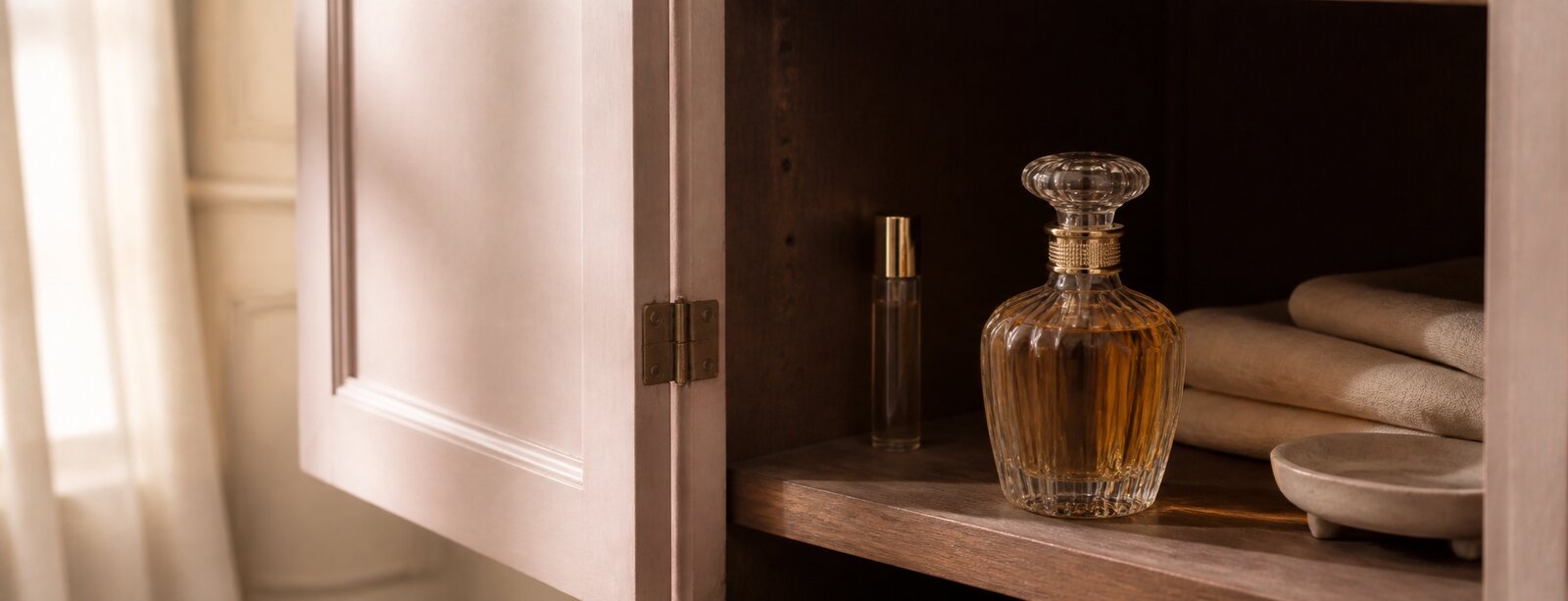
- A drawer, a closed cupboard or a box. Dark, with a steady temperature — steady matters more than cold.
- In its original box if you kept it: that is exactly what it was designed for.
- Upright rather than lying down, so the juice is not permanently against the sprayer or the cap.
- Away from radiators, the kitchen and the car.
What about the fridge?
It works, but hardly anyone needs it, and done badly it is worse than doing nothing: taking a bottle in and out every day subjects it to a constant temperature change, which is the very thing you were trying to avoid. A dark, steady drawer beats a fridge that opens twenty times a day.
If you are going to do it, use a separate fridge at a mild setting, and leave the bottle in there until it is used.
The bottle matters too
- Sprays outlast splash bottles: the juice barely meets the air, and no finger goes inside.
- Opaque or colored glass protects better than clear. It is not only a design choice.
- A decant in a small vial ages faster: more air per unit of juice, and more handling.
- Do not shake the bottle. It mixes nothing and only adds air.
How to tell it has turned
It does not smell rotten, it smells like something else. The signs, from earliest to latest:
- The opening disappears. The first ten minutes — the citrus and the most volatile material — go before anything else, so the fragrance starts straight at the heart.
- A sour or metallic edge appears, especially at the start.
- The alcohol becomes more noticeable than it should be.
- The color darkens. Careful: in juices heavy on vanilla or amber, darkening is normal and means nothing on its own.
Related guides
 Does perfume expire?
Perfume has no expiry date the way food does. What the 12M symbol means, and how to tell a bottle that has turned from one that has merely darkened.
Read guide
Does perfume expire?
Perfume has no expiry date the way food does. What the 12M symbol means, and how to tell a bottle that has turned from one that has merely darkened.
Read guide
 Rediscovering a forgotten perfume: why it feels so joyful
What scent really does with memory, and how to give a forgotten perfume another honest try.
Read guide
Rediscovering a forgotten perfume: why it feels so joyful
What scent really does with memory, and how to give a forgotten perfume another honest try.
Read guide